

Education Supplements Trust Fund?
In 2025, the SC General Assembly passed S.62 (Act 11), which established the Education Scholarship Trust Fund , an ESA-style program providing education scholarships for students in grades K-12. This action completed the pre-K to college scholarship spectrum for the Palmetto State. (The state already sponsored private college scholarships (Tuition Grants, 1971; 1973) and private pre-K scholarships (First Steps, 1999).)
Unfortunately, in 2026, with the ESTF program up and running, some members of the General Assembly are remembering certain details of S.62 differently than we do.
These legislators—who are friends and allies on a wide range of other issues and have an honest difference of opinion from ours—are arguing essentially that the letters “ESTF” could stand for Educational Supplements Trust Fund. They believe that, rather than giving parents the option of bundling any combination of the 15 education options listed in the ESTF bill into a customized program of study for their child, there are actually two classes of options under S.62, Foundational and Supplemental.
Their position could be explained using the metaphor of a house.
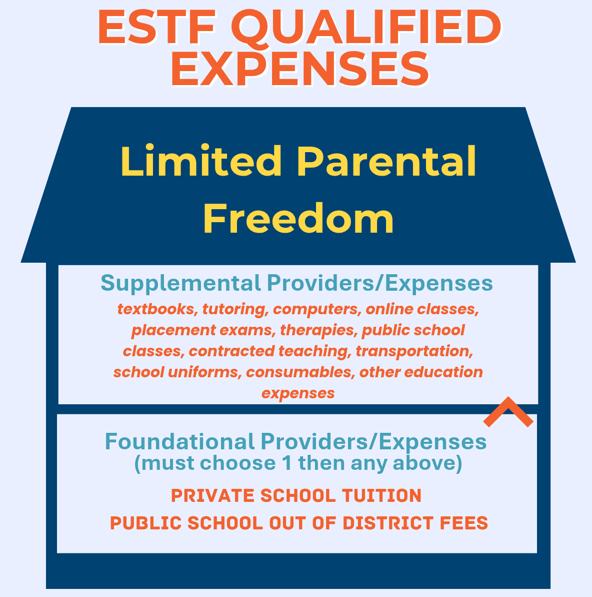
In this view, just 2 of the 14 options listed in the law are permitted to form the Foundation of the house—and one of these two foundations must be selected first before proceeding to the next level. Those two Foundational Options are: a) a private school and b) a public school in a different district from the child’s own.
Then, on that Foundation is built the Supplemental or “Enhanced” services part of the house, of which there are 12 options. In the ESTF case, among those would be expenses like curriculum, therapy, tutoring, or online courses.
This interpretation was advanced in Senate hearings on February 4 and February 19, where it was stated that the legislative intent of S.62 was “the ability for a parent to supplement, to add on.” The example provided was if a parent were using ESTF to attend an independent school (Foundation), and that private school did not offer German classes, the parent could use the ESTF to pay a German instructor or class to add on to the student’s curriculum (Supplement).
Here is what their position looks like graphically, starting at the foundation of the house and working up:
Our view here at Palmetto Promise is very different from this interpretation and always has been during our decade-long advocacy of Education Scholarship Accounts.
Since 2016, Palmetto Promise has advocated “the smartphone of education,” where any of those 14 could be bundled to form a customized education program. As said then, everyone’s smartphone setup is unique. Everyone’s ESTF array of services would be unique as well. In this model, all services are part of the entire house.
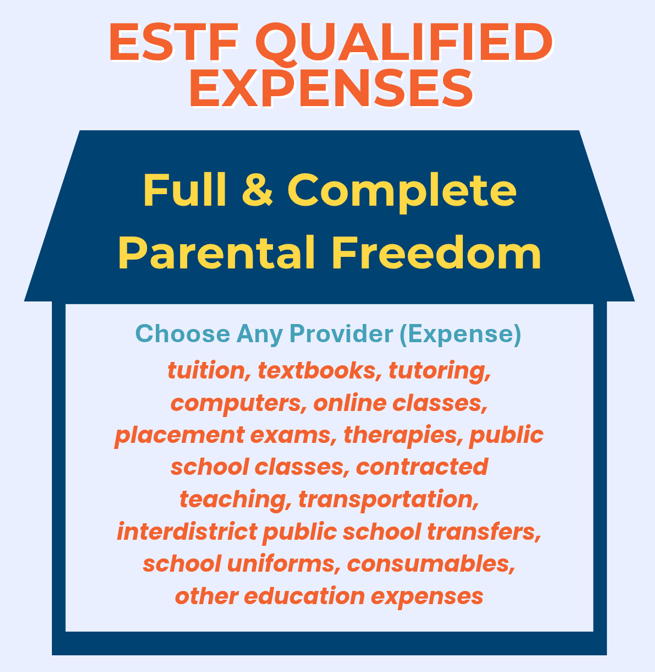
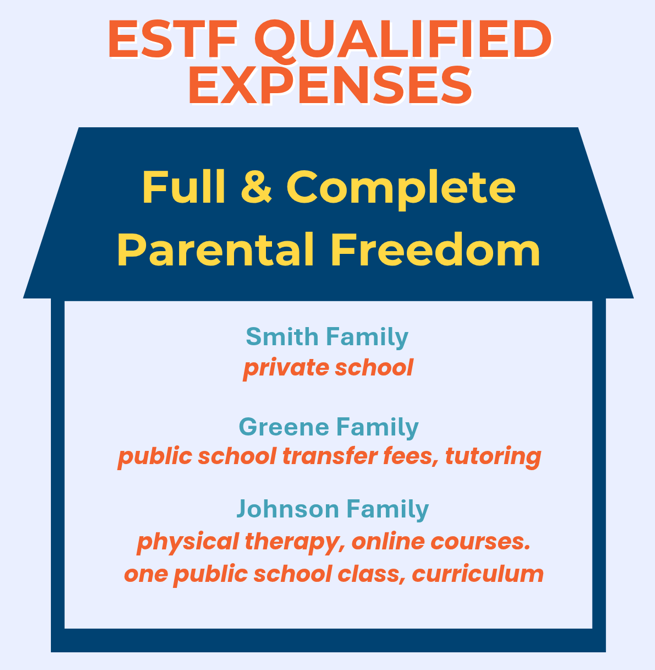
To provide more specific examples, here are three options for how that mix and match (“bundling” or “buffet”)—or as we said in 2016, “a la carte”—could look.
Generative AI estimates that there are over 16,000 combinations of those 14 options!
Notice in one of those options in the graphic, the Johnson Family, the student is not attending a brick-and-mortar school of any kind.
Looking back over our communications since Palmetto Promise introduced the ESA concept to South Carolina (2016-present), we have always said that the full list of options represented a buffet or smorgasbord from which parents could choose. That’s also how I testified before the Senate Education Committee on February 4.
To us, that’s what Section 59-8-110 clearly says.
There are not two lists of approved expenses, there is one list.
We feel that an “Education Foundation with Supplements” mechanism undermines the ESA concept entirely. It offers some choice—-choice through an intervening narrow door—rather than a wide-open world that offers all 14 options.
This Foundational-Supplements understanding of ESTF may be unconstitutional as well. According to Cain v. Horne (Arizona Supreme Court, 2009), a school choice program cannot be a mechanism that offers parents no choice but to “endorse a check over to a private school.” Sure, under ESTF in South Carolina, public school interdistrict transfer would also be an option in addition to private (independent) schools, but would that be enough for the South Carolina Supreme Court?
School choice programs have been struck down twice already (Adams v McMaster 2020; Eidson v. SCDE 2023) in South Carolina because of this very point. It is one of the hinges for what is direct support of schools (unconstitutional) and indirect support for schools/direct support to students (constitutional). That’s why the legal breadcrumbs of Niehaus v. Huppenthal (2013), also in Arizona, are important to follow: that there should be lots of providers for a parent to bundle, not just schools.
Is it worth the risk (and is it right) to undermine the legal position of ESTF and restrict parental choice in the program at the same time?
A plain reading of S.62 and every other ESA statute in the country leaves no doubt that all allowable expenses listed in the subsection (letters a through n in the statute) should be on the table for bundling with no artificial Foundation versus Supplement division.
If that creates an option that involves no full-time attendance at a brick-and-mortar school, so be it. Parents deserve that right if it is the best bundling of services for their child.
With immense respect for those who hold a different view, we believe that bundling in scores of ways is what education freedom is all about, what S.62 is all about, and what Palmetto Promise’s has been saying for a decade.