

Potholes and Choice Lanes. Oh my!
Whether your frustration with South Carolina roads is time in traffic or poor pavement quality, help could be on the way.
Earlier this week, the South Carolina Senate, under the leadership of Senator Larry Grooms (R-Berkeley), passed S.831, the Department of Transportation reform bill. The 33-page legislation seems to have something for everyone, except for any direct appropriation of funds; money reforms must begin in the House.
The adjacent Palmetto Promise Institute Infographic simplifies the recommended changes. We count about 19 key reforms, but we have grouped them into 8 policy areas.
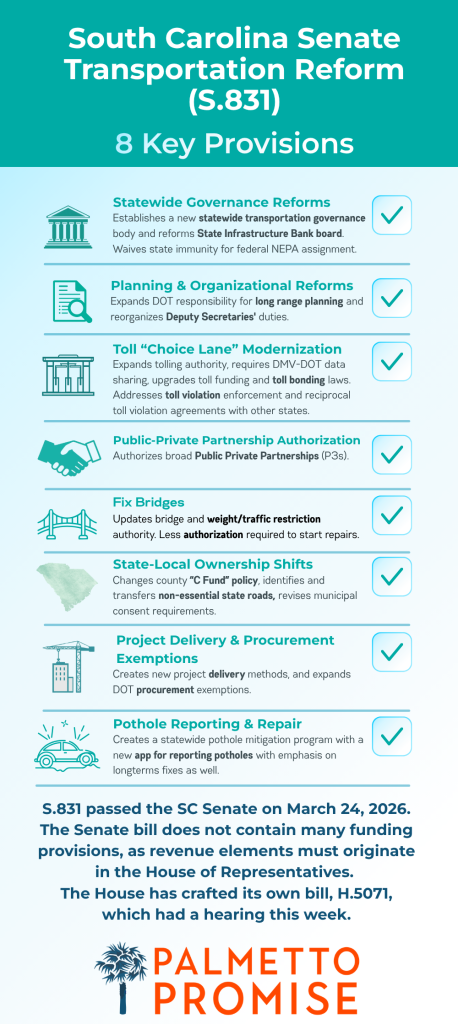
Statewide Governance Reforms. Control of transportation governance, including the DOT and the separate State Infrastructure Bank (SIB) has been evolving for decades. With changes in S.831, evolution is not complete, but there is a new Coordinating Council for Transportation and Mobility to help oversee statewide planning, and the DOT Secretary becomes an ex officio member of the SIB. A more robust change in governance to give the Governor more authority is clearly called for, but again, this is a start.
Planning & Organizational Reforms. Clarifies that the Department, not the Commission, must develop the Statewide Transportation Plan. Establishes detailed criteria for project prioritization. Reorganizes and defines the responsibilities of Deputy Secretaries for Finance, Engineering, Intermodal/Freight, and Planning.
Toll “Choice Lane” Modernization. This is a biggie. The bill expands when tolls may be imposed but requires authorization by the General Assembly, limits tolls to choice lanes that add capacity, requires the DOT to evaluate whether tolling is feasible for major projects, and orders that tolls must cease once costs are paid.
The legislation further enables state agreements to enforce toll violations across state lines via registration holds. DMV must also share updated registration data monthly for toll enforcement purposes. The measure grants DOT authority to designate, plan, and operate toll facilities (with oversight). Standards for toll bonds, bond approvals, and redemption are updated. Toll violation enforcement using electronic toll systems and photo enforcement will be allowed.
Public-Private Partnership (P3) Authorizations. DOT may enter P3 agreements for planning, financing, constructing, and operating transportation infrastructure.
Fix Bridges. There are various reforms in the bill related to bridges, such as expanding DOT authority to restrict weights/loads and the ability to impose temporary weight/speed limits to protect infrastructure.
State-Local Ownership Shifts & Relationship Changes. This is another key component. The legislation allows transfer of non-essential roads to local government. DOT must publish a list of non‑essential roads, and ownership can transfer to counties or cities with funding support. Changes to the county “C‑Fund” Program include increased gasoline user‑fee allocation to counties, new requirements for county transportation committees, and a donor county reimbursement structure.
Project Delivery & Procurement Exemptions. The Senate bill authorizes solutions to increase efficiency, such as Phased Design‑Build and Construction Manager/General Contractor project delivery methods.
Pothole Reporting & Repair. The legislation creates a Statewide Pothole Mitigation Program that sets up a public reporting system for potholes via app, website, or phone. DOT must repair potholes within 7 days of report. Recommends $15M annually from the Infrastructure Maintenance Trust Fund (IMTF) for full‑depth pavement repairs of repetitive potholes.
The House of Representatives will get its shot at DOT reform either by amending S.831 or by passing H.5071, which got a hearing this week. The bill that passed the Senate was mostly devoid of any references to dollars, as revenue bills must originate in The People’s House, the House of Representatives.
DOT and infrastructure reforms are a long time coming for the state with the fourth largest state-maintained highway system in the country. But there are many legislative hurdles to clear before citizens will see even a plan for relief.
Nevertheless, it is some comfort that the nation’s fastest-growing state is at last addressing systemic problems and advancing urgently needed infrastructure reforms.