
2026 SC School Report Cards Show Promise
The South Carolina Department of Education recently released the 2026 School Report Cards. Required to satisfy federal accountability standards, these report cards grade every public school (traditional and charter) on a wide variety of criteria, such as standardized test scores, graduation rate, college and career readiness, and student progress. They also provide families with a valuable resource to evaluate different school options when looking to relocate or take advantage of inter- or intra-district open enrollment.
According to a press release from the South Carolina Department of Education, highlights from this year’s report cards include:
- The highest on-time graduation rate in 10 years, at 87.5%;
- Twice as many middle schools earning a rating of “Excellent” or “Good” for student progress since 2024;
- Overall score improvement in 25% of South Carolina elementary schools; and
- Strong improvements in high-poverty schools.
Below, we take some time to highlight some additional data points and trends from this year’s release beyond the Department’s press release.
Schools Enjoying College and Career Preparation Success
This year, 13 schools prepared all (100%) of their students for college or a career, up from 9 schools last year. These schools are split between districts: Aiken, Charleston, Horry, Richland One, Berkeley, Darlington, the Charter Institute at Erskine, Orangeburg, and two Governor’s Schools – the School for Agriculture and the School for Science and Math. All of the 2025 schools maintained their 100% rating from 2025, plus HCS Scholars Academy High School, Branchville High School, Richland One Charter Middle College, and Brashier Middle College Charter High School.
Most importantly, most of these schools who scored 100% are non-traditional public schools. All but five are magnet schools – of the remainder, two are special schools, two are traditional public schools, and one is a charter school. One of those public schools is Aiken Scholars Academy, which was recently named the best high school in the United States by U.S. News and World Report.
This success not only points to the hard work and dedication that these schools have put into preparing their students for life after high school, but also shows that students are able to thrive in alternate educational environments. Public charter and magnet schools serve students who want something different from the usual school setting, such alternate class arrangements or an increased focus on specialized curriculum in STEM or performing arts.
Especially in this case, “different from the usual” does not mean “low-performing.”
We Still Aren’t Preparing Everyone for Life After High School
Despite the great successes that some schools are experiencing, statewide there is a significant gap between our schools’ and districts’ on-time graduation rate and the percentage of graduates who are college or career ready. The gap varies widely – Pee Dee Math, Science and Technology Academy graduated 100% of their students on time this year, but just 23.5% qualified as college or career ready. The now defunctgraduated 78.9% of their students on time last year, and just 5.3% of them were college or career ready. The school was formerly authorized locally by the Charleston County School District but was recently “reabsorbed” by the District due to poor performance. In some ways, public charter schools are more accountable for their students’ results than traditional public schools – charter schools can close completely, while traditional public schools are generally only subject to state takeover (which they will later graduate from and regain their autonomy after a few years).
Many of the schools mentioned above are graduating everyone on time and college or career ready, but the average gap across the state is still 8.6 percentage points.
At the district level, Chester County School District has the largest gap – an 85.9% on-time graduation rate and just 52.4% are college or career ready. The Governor’s Schools for Agriculture and for Science and Math are the only two “districts” (really special schools, but coded as districts in the report card) that graduated every student on time and college or career ready.
This points to a significant need for a shift in focus in K-12 education. Over the last few years, significant investments in math and reading are showing promise, but we must expand our focus to develop stronger college and career readiness programs. With the start of a new legislative session coming in January, we have an opportunity to revolutionize college and career pathways in South Carolina, and plenty of possible ways to do it.
Schools are Improving Overall
Perhaps most importantly, South Carolina schools as a whole are improving. In the chart below, we show how the number of schools in each category changed over the last three years:
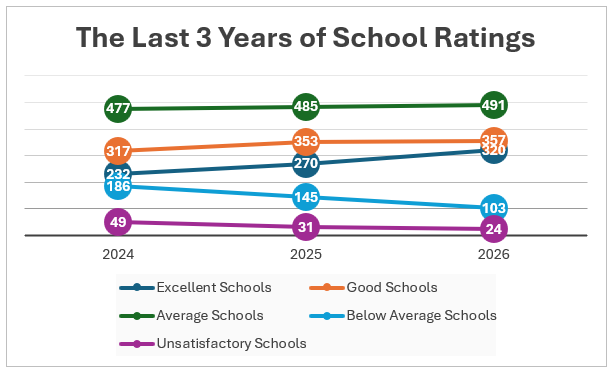
We can see that the number of “Average” schools remains about the same, while the number of “Below Average” and “Unsatisfactory” decrease and “Excellent” and “Good” schools increase. This trend is driven by a collective effort across every level of government – parents are investing in their child’s education, schools are holding students to high standards, and the state is holding schools accountable for their results. In recent years, South Carolina launched two key projects aimed at improving student outcomes: the Palmetto Math Project and Read to Succeed.
Final Takeaways
No matter how much our schools improve, it can never be enough. Our students deserve nothing but the best, and that means never being satisfied with our school grades. We must always be looking to innovate so progress does not stagnate. We are moving in the right direction, but we are far from finished.