
Chasing the Razorbacks? Assessing Arkansas and South Carolina Education Miracles
In a recent article from Fox News, Arkansas Governor Sarah Sanders claimed that the improvements in education driven by recent reforms positions her state as a “blueprint” for education reforms nationwide.
Let’s take a minute to break down Arkansas’ education reforms to test that claim (at least as they compare to South Carolina). Is Arkansas really leading the way in education reform? What results are they seeing? And perhaps most importantly, are they doing something that we are not?
What did Arkansas do?
Governor Sanders signed Senate Bill 294 into law in 2023, creating the LEARNS Act. Each letter stands for a unique focus area, Literacy, Empowerment, Accountability, Readiness, Networking, and School safety, and within each focus area are individual action items.
For example, some of the action items include:
- Literacy – Conducting a comprehensive review to ensure schools and districts are implementing the Arkansas Right to Read Act, AR Code § 6-17-429 (2019), to be completed within ninety (90) days. The comprehensive review should ensure that, at minimum: Every student is receiving evidence-based literacy instruction with a curriculum aligned to the Science of Reading; and every teacher has received training in the science of reading.
- Empowerment – Coordinating, alongside the State Board of Education, policies that streamline processes to continue, expand, and replicate effective charter schools.
- Accountability – Publishing on the agency’s website, within ninety (90) days, a user-friendly, readable, and accessible list of alternative certification programs to help districts recruit high-quality teachers.
- Readiness – Identifying available funding for high-quality workforce apprenticeships and other high-quality work-based learning workforce programs, including those within Arkansas education institutions.
- Networking – Monitoring and publicly reporting in no more than ninety (90) days on student access to high-speed internet in each school and school district.
- School Safety – Implementing strategies to increase the presence of trained law enforcement officers and Commissioned School Security Officers on campuses.
How do Arkansas’ scores compare to ours?
According to the article, since passage of the LEARNS Act in 2023, students across all grades in Arkansas saw a 7 percentage point increase in proficiency rates on state tests, with more than half of all kindergarteners achieving proficiency in every subject. Right now, 44.2% of Arkansas’ students are proficient in math, 44% are proficient in science, and 39.5% are proficient in English Language Arts.
Let’s compare these numbers with South Carolina (using 2024-25 school year data, which is the most recent available). 60.3% of those taking SC READY (8th grade and below) are proficient in English language arts and 44.5% are proficient in math. 68.5% of our high schoolers are scoring “C” or higher on their end-of-course exams in English, and 51.6% are doing so in Algebra I.
Overall, our scores are improving, though not always at the same pace as Arkansas. Since the 2022-23 school year, our SC READY English proficiency rate improved 6.4 percentage points, math improved just 3.6 percentage points, and our proficiency rates for English and Algebra I improved 4.1 and 9.8 percentage points, respectively.
Although both states are improving their scores on their own tests, if we want an objective measure of progress, we must compare scores on the National Assessment of Educational Progress (NAEP). Administered regularly across the country, NAEP describes itself as “…providing educators, policymakers, elected officials, and parents across the country with invaluable information regarding how you and your peers are doing compared to other students in participating large urban districts, other states, and the nation.”
The National Center for Education Statistics selects a representative sample of students and schools in 4th, 8th, and 12th grade to take the exam, and NAEP scores do not affect students’ grades in their normal coursework.
Below is a table that shows the difference between our scores in math and reading for 4th and 8th grades in 2024 (12th grade was not tested that year in South Carolina), as well as the change in that score from 2022. South Carolina’s score is in blue, Arkansas’ is in orange.
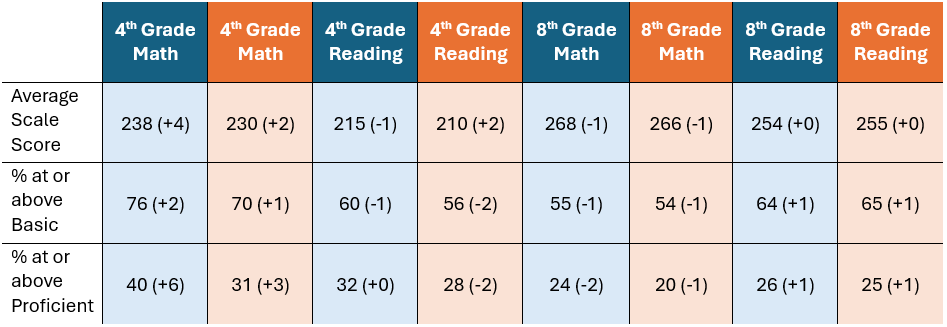
As we can see, South Carolina scores higher than Arkansas in both subjects, and our changes in scores are similar between years. That begs the question—what is happening in Arkansas? How are their scores on their state test improving so much faster when we have similar education improvement laws and initiatives (i.e. the Palmetto Math Project and our efforts to align our literacy instruction with the Science of Reading)?
The Difference
I believe that Arkansas has shifted its focus in a way that South Carolina has yet to do: They are finally prioritizing the student and families. Jonathan Turley makes this point well in a recent opinion piece with Fox News —states across the country are bound by competing views in education and who is most important. He quotes one school board member from Iowa who believes that the real goal in education is to teach kids what society wants them to know, not what parents want them to know.
Yes. Society wants our kids to know how to read, how to balance a checkbook, and how to provide for themselves and their families. However, beyond a handful of basic life skills, the rest is open to interpretation. We are all too familiar with the battle over social-emotional learning in our schools (and that is not something that we will dive into here). Arkansas has settled that fight by giving families options and rewarding teachers who are actually educating children.
South Carolina is on the way. Our education savings account (ESA) will have just 15,000 students next year, but Arkansas’ ESA is truly universal (i.e. all students are eligible to receive funding, and everyone receives funding based on that year’s appropriations) and serves more than three times as many students. We have already invested in improving our reading and math instruction, and we are piloting strategic compensation programs that reward the most effective teachers.
The bottom line is this: Arkansas may not be a national leader in school performance (neither are we!), but they are setting the standard for what it looks like to empower students, families, and educators in a way that betters the education system as a whole.
From that, South Carolina could learn a few lessons.