
Election Reform: Another Round is Needed for South Carolina
South Carolina has made significant progress concerning election reform. The latest Election Integrity Scorecard from The Heritage Foundation which was updated in November of 2025, ranks South Carolina pegged at 9th best in the country with a score of 81 out of 100. North Carolina scored 70 and Georgia 83. The highest scores in the country are Arkansas and Tennessee, with 91. No state has a perfect score of 100. However, the scorecard highlights additional election reforms that lawmakers should consider.
Election Law Changes 2022
Reforms like those encouraged by Palmetto Promise are much of the reason for South Carolina’s Top Ten ranking and prompted S.108, a comprehensive election reform bill passed by the General Assembly in 2022. After the 2020 election, Palmetto Promise reviewed election laws and asked the legislature for 20 reforms, and 17 of those were enacted.
The most significant changes targeted absentee voting by mail. Anyone returning another’s ballot must now show photo ID and is limited in how many ballots they can personally return, to eliminate ballot harvesting. S.108 established two weeks of early in-person voting; unlike the previous system, voters no longer had to provide a qualifying reason to vote before Election Day. Taken together, Palmetto Promise found these reforms reduced reliance on mail-in ballots.
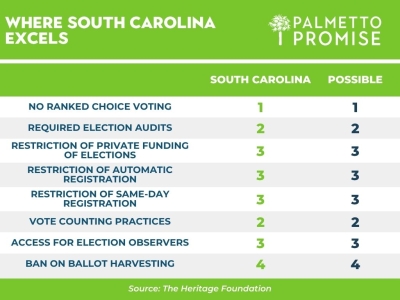
The Heritage scorecard consists of 14 subject areas with numerous subsections under each. Of the 14, South Carolina enjoys a perfect score in these categories.
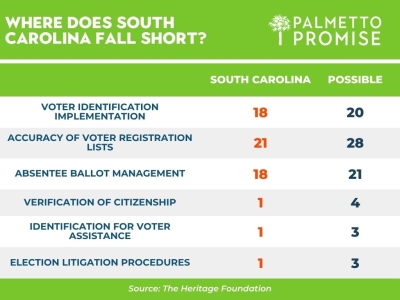
So, with that many correct and that many points earned, where does South Carolina fall short?
What can SC do better?
Voter ID Implementation:
South Carolina’s photo ID requirement has a built-in loophole: it allows voters without an ID to cast a ballot by affidavit instead. There is no reason to make such an exception that undermines requiring ID in the first place.
Accuracy of voter registration lists:
South Carolina does not cross-check registration addresses against county tax records to confirm an address isn’t a commercial or industrial property, or a vacant lot. The state doesn’t flag anomalies like twenty people registered at a single-family home, and election officials don’t investigate registrations that share an address with only slight name differences. They also don’t check with private-sector entities like credit agencies for address changes. The polling places electronic poll books don’t include photographs of the registered voter. Continuing, the state courts don’t share info with election officials on matters like citizenship status or felony convictions. The state already has the information closing the gap should be a straightforward data-sharing fix.
Absentee Ballot Management:
Currently, state law places no limit on how many absentee ballots an individual can witness. More importantly SC has no signature comparison requirement to verify an absentee voter’s identity. There is also no procedure to investigate a registration when an absentee ballot is returned as undeliverable by the post office. These could nonetheless be a useful tool in confirming the accuracy of the voter rolls.
Verification of Citizenship:
The weakest category on the entire scorecard, South Carolina does not use the Systematic Alien Verification for Entitlement (SAVE) program to help confirm registrants are citizens.
This gap may soon intersect with a much larger national fight. On June 29, 2026, the U.S. Supreme Court agreed to hear a case over Arizona’s 2022 law requiring documentary proof of citizenship. This includes a birth certificate, passport, or similar document. The case reached the Supreme Court because an appeal by of the Republican National Committee after the Ninth Circuit ruled the document requirement conflicts with the federal National Voter Registration Act, which requires voters to sign an attestation of citizenship under penalty of perjury. Oral arguments are set to begin this October. The outcome will settle an important question relevant to the state: how much documentary for proof of citizenship is demanded from voters. If the court sides with Arizona, there will be a clearer path for South Carolina to adopt the SAVE program without challenges from the federal law.
Identification for voter assistance:
South Carolina does not require identification from those who assist voters at the polls, leaving another point of the process without verification.
Election litigation procedures:
Any changes to the state’s election laws by a court settlement do not require the approval of the legislature. Election laws are supposed to be made or changed by elected representatives. It makes election rules easier to alter through lawsuits and settlements rather than public debate and through the legislative process. Second, South Carolina residents don’t have the standing to sue election officials who fail to follow state law. This leads to less accountability and reliance on the government, which may or may not choose to act.
Conclusion
South Carolina has been among the leading states in election reform over the past several years, coming close to earning one of the highest Election Integrity scores in the country. The reforms Palmetto Promise advocated for in 2022 addressed many concerns and strengthened confidence. However, the Heritage Foundation’s scorecard makes it clear that work still needs to be done. Closing the remaining gaps in accuracy in voter registration, absentee ballot security, citizenship verification, voter assistance, and election litigation procedures would further strengthen the state’s election system. While South Carolina has improved, another round of reforms would help ensure secure, transparent, and accountable elections.