
The Energy Equation: Embracing Data Center Innovation While Protecting Ratepayer Wallets
Every time you ask AI a question, stream a show, post a photo, or save something to “the cloud,” a data center is at work. You may not even realize it, but data centers for AI and cloud-based storage are a significant part of our lives and have legitimate growing needs. But there is an alleged downside to these facilities: data centers are major energy consumers.
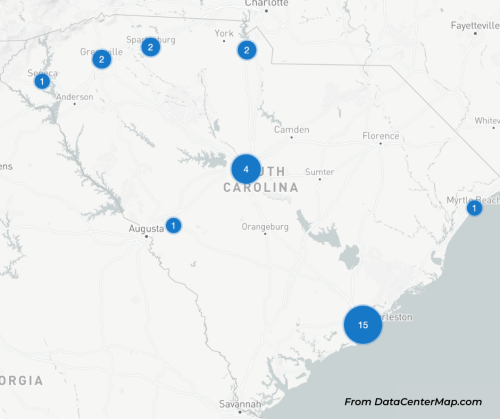
Currently, South Carolina is home to 28 data centers sprinkled across the state. There is a significant concentration in the Lowcountry, which hosts more than half of these facilities.
Though data centers are critical to our future, they remain mostly outside of the public eye and are not widely understood.
What are data centers?
Data centers are expansive warehouses equipped with servers and systems for storage, networking, cooling, security, and power backup. They form the backbone of our digital lives. Think of them as the physical location of “the cloud.” There are various types of data centers, including enterprise, hyperscale, edge, managed, and colocation.
Types of data centers
- Enterprise data centers are in-house, personalized facilities. They are owned and operated by a single company for its own internal needs. Generally, the businesses that can afford these are very large banks or tech companies.
- Hyperscale data centers are enormous facilities used by major service providers such as Amazon, Microsoft, and Google. These are usually company-owned facilities that handle massive amounts of data supporting millions of users and client companies. Hyperscale data centers are often classified as public cloud data centers. When you save something to your Google Drive, that is made possible because of these hyperscale data centers.
- Edge data centers are local facilities owned by cloud providers, telecom companies, or individual companies. These data centers bring computing closer to users to reduce latency or time spent directing data. They are also typically categorized as public cloud data centers.
- Managed data centers are externally owned and run facilities. These data centers lease out servers to a client company, which allows the facility to handle the administration, monitoring, and management. Unlike the public cloud data centers, these offer privacy while still outsourcing burdensome data center management. Oftentimes, a hospital or a large law firm will have its own data center for patient/client information storage.
- Colocation data centers are external housing for company-owned servers. Companies provide their equipment and manage it, while the facility leases the physical space, power, cooling, and security. Similar to managed data centers, these offer privacy and the ability to outsource.
What is the benefit of the spread of data centers?
On the positive side of the equation, data centers offer localities a substantial return on investment. They generate millions in property tax revenue without imposing additional stress on roads, traffic systems, or creating pollution typically associated with factories or industrial plants. Hyperscale and edge data centers in particular, are expected to grow the most to meet increasing demand for cloud computing, large data storage, and processing needs for individual users everywhere.
Make no mistake, this is the free market at work. As our reliance and use of technology have changed, the market has risen to meet the moment. That’s why data center supply is projected to expand by more than 30% in the next two years.
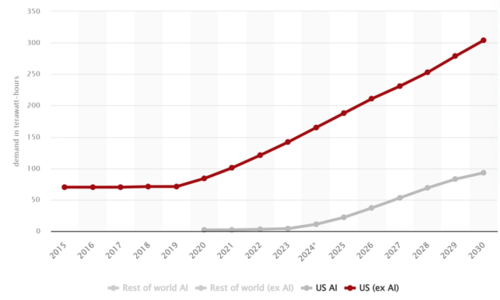
US Data Center Power Demand (2015 to 2023, with a forecast to 2030)
Data center electricity costs
Historically, the cost of expanding power infrastructure has been shared across the broader customer base—industrial, commercial, and residential. However, that approach is no longer suitable in an era defined by the immense energy demands of data centers. Local ratepayers should not have to foot the bill for data centers’ energy use without reciprocal benefits.
But here’s the deal. The tech industry does not need them to; they have access to sufficient capital and are willing to invest in new infrastructure to support data centers. In fact, major tech companies across the nation are investing in innovative energy production (like small modular reactors) to fuel their data centers. Projects like the potential completion of V.C. Summer 2 and 3 could also be commissioned by companies to power data centers, without any costs to ratepayers.
Energy use is always an important economic development consideration for the Palmetto State, because South Carolina already has energy supply challenges given our growing population. In debate on the sweeping energy bill (H.3309) passed in spring 2025, the South Carolina General Assembly frequently discussed data centers and their significant use of energy. That legislation erects guardrails to keep large-scale energy users responsible for the cost of their growth and prevents costs from being passed to ratepayers.
Under the new law (Act 41), data centers are required to cover the power infrastructure costs through higher rates, minimum billing commitments, and without a choice of energy provider. An earlier version of the bill contained a binding 15-year contract that guaranteed payment for the projected level of energy usage, even if the company’s actual consumption later declines or its operations relocate. That provision was ultimately removed in Conference Committee.
However, some critics still argue that the new law favors large monopoly utilities and limits flexibility by locking companies into long-term utility contracts in a market where energy choice is already constrained. That’s why, as South Carolina competes for high-tech investment, balancing cost-recovery with flexibility and innovation will remain a critical conversation.
Benefits and Challenges
The growth of data centers in South Carolina brings several advantages, including economic growth and enhanced digital infrastructure. Data centers create jobs and stimulate local economies, and they can be a great way for landowners in rural areas to make a steady profit. The United States Census Bureau found that data center employment rose by 60% from 2016 to 2023, with no signs of slowing down. This trend suggests that data centers could seed high-paying, skilled jobs across South Carolina. Additionally, the robust digital infrastructure is another benefit of data center growth. Data centers’ digital infrastructure supports the increasing demand for cloud services, online storage, and connectivity. This advancement facilitates greater access to remote work, telehealth services, and online education, which in turn attracts valuable business investments.
The Equation
It is a complicated equation:
- Data centers are essential to life in the 21st Century, pay taxes, and must be built somewhere. Why not here?
- But…data center energy consumption is colossal and can strain existing power grids.
- Then…data centers should be allowed to develop their own independent generation capacity using their own capital, without being constrained by unnecessary regulation.
- Nevertheless, accountability is essential, especially in light of incentives such as tax breaks for data centers.
Conclusion
The question is not whether data centers will grow, but where they will expand. While we all recognize that AI is the future, not enough of us understand that, given the right answers to the “equation,” the Palmetto State could warmly embrace the data centers that support that future.
South Carolina can be a magnet for next-generation technology, built on reliable, affordable, and future-ready energy.
This is essential, because in the age of AI, the states that power the cloud will power the economy.
Let’s make sure South Carolina is one of them.
An earlier version of this article erroneously reported that the 15 year utility contract provision remained in the final version of H.3309. It was removed in conference committee, and we have updated our report to reflect that.