

The History & Future of “The Success Sequence”
According to the Brookings Institution and the American Enterprise Institute (AEI), three simple steps, obtaining at least a high school diploma, securing full-time employment, and waiting until marriage to begin having children, can drastically lower your chances of experiencing poverty. Known as “The Success Sequence,” this proven formula was first identified by social historian Barbara Dafoe Whitehead and author Marlien Pearson. Whitehead makes clear that The Success Sequence is about teens and young adults doing things at the right time and in the right order. In addition, Whitehead believes that too often, young people are told about aspects of the sequence, such as waiting until marriage to have children, too late or not at all. The underlying component of The Success Sequence consists of teaching the importance of healthy relationships and the impact they can have on the quality of a family’s life.
The Specific Steps in the Sequence
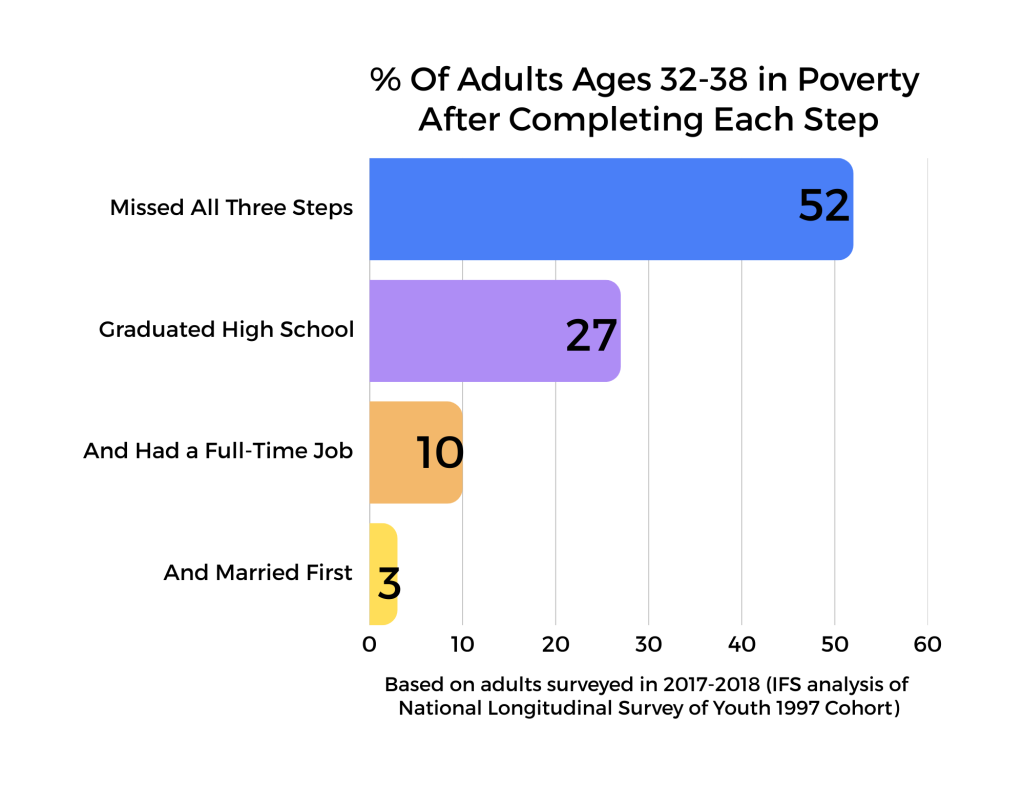
The first step in The Success Sequence, obtaining a high school diploma, is perhaps the most important. According to the American Enterprise Institute, individuals between 32-38 who graduated from high school have a 70% chance of not being poor. Graduating from high school opens up the doors to further education and job opportunities that help uplift young people.
The second step in The Success Sequence, securing a full-time job, is one of the surest methods for obtaining financial security. Among those between 32-38 who graduate from high school and have found a full-time job, only 10% have experienced poverty. Besides providing money, a full-time job also gives an individual a purpose and a sense of community, all of which contribute to a happier life.
Finally, the third step in The Success Sequence, marrying before having children, ensures long-term happiness and financial security for families. Among adults who have completed the first two steps of the education sequence and marry before having children, only 3% experience poverty. Choosing to wait to have kids until marriage is the right step for building a stronger family.
Success Sequence as Legislation
In Tennessee, The Success Sequence became a part of the school curriculum in that state after HB. 178 was signed into law by Governor Bill Lee on April 4th, 2025. The Success Sequence will be incorporated under Family Life Education starting in the 2026-27 school year.
In Alabama, the Success Sequence formula was approved to be taught in public schools after Gov. Kay Ivey signed the bill into law on May 20th, 2025. The bill cleared the House and Senate with unanimous votes. As with Tennessee, the Success Sequence will begin to be taught in the 2026-27 school year.
Currently, Indiana lawmakers are creating legislation that will educate children on the importance of pursuing the Success Sequence. According to the Indiana Capitol Chronicle, Senate Bill 88, authored by Sen. Gary Byrne, proposes to expand the state’s “good citizenship instruction” to include the research done by the Brookings and American Enterprise Institute. Governor Mike Braun signed SB.88 on March 5.
Other states, such as Ohio, Mississippi, Iowa, Kentucky, and Texas, have proposed similar legislation incorporating The Success Sequence.
Opposition to the Legislation
Opponents of the bill are concerned that character-related education will discourage students who are from families that suffer from poverty. A more practical way to view The Success Sequence, however, is education designed to empower young adults, even those from impoverished backgrounds, to initiate the change necessary to be successful. Even though structural obstacles are a roadblock to many individuals in America, there can be no doubt that the individual choices a person makes can have an enormous impact on his or her circumstances. The Success Sequence is designed to help create a path for those suffering from obstacles such as poverty.
Prospects for Passage in South Carolina
While South Carolina has laws on the books, such as the Character Education and the Read to Succeed Act, the latter of which focuses on literacy as a determinant of success, the Palmetto State has yet to incorporate The Success Sequence into its education curriculum. According to World Population Review, South Carolina is currently ranked as one of the poorest states in the country, maintaining a poverty rate of 14.6%.
If South Carolina is to become an economic powerhouse and a top destination to raise a family, our legislators must tackle the problem of poverty by showing the way out. Educating its citizens on the importance of The Success Sequence is a good step in that direction.