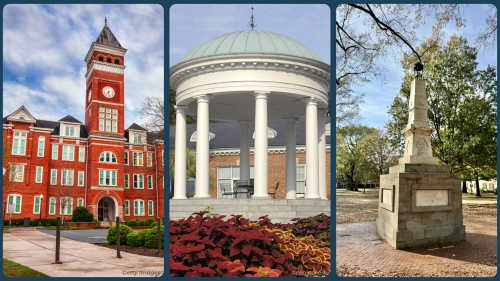

Three University Institutes in South Carolina You’ve Probably Never Heard of But Should Know
University institutes may not always grab headlines, but their impact can be felt far beyond campus. These organizations bring together students, faculty, and community members to explore big ideas, host thought-provoking events, and sometimes even shape public policy.
While you might be familiar with popular centers focused on athletics, history, business, or health sciences, South Carolina is also home to lesser-known institutes that are making significant contributions to embracing the founding principles of civic life, the morality of free market economic thought, and the importance of civil and open public discourse.
Below are three such institutes you may not have heard of but should get to know!
Snow Institute for the Study of Capitalism (founded 2005) – Clemson University
A multidisciplinary institute housed in the Wilbur O. and Ann Powers College of Business, the center began as the Clemson Institute for the Study of the Moral Foundations of Capitalism. With a transformational $25 million gift from Dave and Lynette Snow, it is now known as The Snow Institute for the Study of Capitalism. The Institute is dedicated to examining the moral, political, and economic foundations of capitalism. Its flagship program, the Lyceum Program, is currently the sole university program focused on liberty, capitalism, the American founding, and moral character.
The institute engages students, academics, and the public in discussions with great attention given to one central question: Is capitalism a just and moral system? Through courses, lectures, and research, it encourages a deeper understanding of the principles behind free markets and their role in a free society.
The Institute is directed by Political Science Professor Brad Thompson, author of the magisterial America’s Revolutionary Mind: A Moral History of the American Revolution and the Declaration That Defined It. Dr. Oran Smith interviewed Dr. Thompson about the work of the Snow Center in an early episode of Beyond Policy. Among the founding faculty members of the Center are three eminent free market economists associated with Clemson: Professors Bobby McCormick, Robert Tollison and Bruce Yandle.
Clemson is also home to The Hayek Center for the Business of Prosperity (2018) directed by Reed Watson. The Center “advances voluntary exchange and competition in the marketplace as the means of expanding prosperity.” The Center provided legislative testimony and research in support of Palmetto Promise Institute’s successful efforts to repeal Certificate of Need.
The Cincinnatus Center (founded 2022) – Coastal Carolina University
The Cincinnatus Center at Coastal Carolina University is dedicated to studying, discussing, and promoting civic education, civic virtue, and traditions of political and economic thought, both within the university and in the greater Conway and Myrtle Beach communities. The Center is also working on plans to go statewide.
The center is home to initiatives such as The Forum on Liberty and the American Founding and the Summer Civics Institute, and it encourages student engagement in related academic programs, including minors in American Studies and Political and Economic Thought.
One of its signature outreach efforts is the Summer Civics Institute, a week-long professional development program for middle- and high-school social studies teachers in Horry and surrounding counties. Sponsored by the Jack Miller Center, the institute equips educators to lead students in examining primary documents from American political thought. Topics include constitutional ratification and interpretation, slavery and the Civil War, presidential power, political ideology, and the Civil Rights era. The program also supports South Carolina’s recently enacted REACH Act, which requires instruction in the U.S. Constitution and other foundational texts.
The Cincinnatus Center was founded in 2022 and its strategic plan was officially endorsed by the Board of Trustees in 2024. It is led by Coastal Carolina faculty members Drs. Drew Kurlowski and Kimberly Hurd Hale.
Center for American Civic Leadership and Public Discourse (founded 2025) – University of South Carolina
Approved by the USC Board of Trustees on June 20, 2025, this new academic center in the McCausland College of Arts and Sciences is preparing to launch programs aimed at addressing one of the most pressing challenges of our time: deep political polarization. Through public events, academic offerings, and scholarly research, the center will promote three forms of “literacy” essential to a healthy democracy — dialogic literacy (civil, evidence-based debate), cultural literacy (understanding America’s founding traditions), and civic literacy (the duties of citizenship).
Its first public events are scheduled for September, including a conversation between scholars Robert P. George and Cornel West, and a Constitution Day lecture by Emory legal scholar John Witte. Future programs will explore South Carolina’s role in America’s founding, the rule of law, ethics, and more.
By connecting the classroom to real-world civic life, the center aims to equip students and citizens alike with the skills needed for constructive civic engagement.
Why do these institutes matter?
These institutes may not always be in the spotlight, but they shape conversations that extend far beyond campus borders. By promoting the founding principles of civic understanding, examining free market economic principles, and encouraging informed public discourse, they contribute to intellectual strength and civic engagement in South Carolina and beyond.
Built on the foundations of freedom, civic responsibility, and the principles of a free society, the institutes bridge classroom learning with real-world application. Whether you’re a student looking for academic enrichment, a community member seeking thoughtful events, or simply someone curious about the big questions shaping our society, these centers are worth exploring.