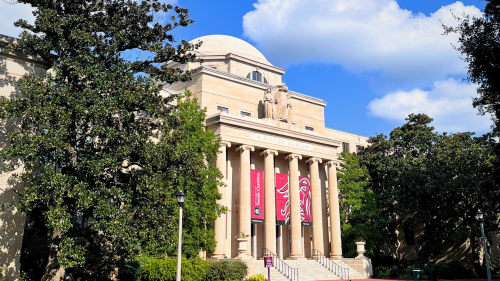
The University of South Carolina System is taking a leadership role—alongside public higher education systems in Florida, Georgia, North Carolina, Tennessee, and Texas—in creating a new accrediting agency focused on public institutions. This first-of-its-kind collaboration, known as the Commission for Public Higher Education (CPHE), aims to strengthen academic excellence, prioritize student outcomes, and streamline accreditation processes to reduce costs and save time for member institutions.
Why Accreditation Matters
Higher education accreditors have many roles. Most importantly, when an institution is associated with an accreditation system, the school is then able to receive federal financial aid like Pell Grants, for example, that are then awarded to students. USC, like most public universities in the Southeast, is currently accredited by the Southern Association of Colleges and Schools Commission on Colleges (SACSCOC).
However, concerns have grown that some struggling institutions remain accredited despite poor results. For example, more than fifty four-year universities accredited by SACSCOC report graduation rates below 20%. With student debt doubling in the last ten years, reaching $1.75 trillion, we (literally) cannot afford to continue in this failing accreditation model that does not consistently hold institutions accountable for student outcomes.
By joining with peer systems to create CPHE, USC is helping chart a new course for public higher education accreditation—one built around shared missions and challenges of state institutions.
The Commission for Public Higher Education
CPHE was announced in June 2025 by six major state university systems:
- University of South Carolina System – includes 8 institutions
- Texas A&M system – includes 12 institutions
- University System of Georgia – includes 26 institutions, such as UGA and Georgia Tech
- State University System of Florida – includes 12 institutions, such as UF, CSU, and University of South Florida
- University of Tennessee system – includes 5 institutions
- University of North Carolina system – includes 16 institutions, such as Appalachian State and UNC Chapel Hill
According to the Commission for Public Higher Education, this accreditation system will “laser-focus on student outcomes, streamline accreditation standards, focus on emerging educational models, modernize the accreditation process, maximize efficiency without sacrificing quality, and ensure no imposition of divisive ideological content on institutions.”
Why Create a New Accreditation Model?
Federal regulatory changes in 2020 gave colleges and universities the freedom to choose their accreditor rather than being locked into one based on geography.
Additionally, in an April 2025 Executive Order, President Donald Trump revealed that certain accreditors unlawfully require schools to adopt diversity, equity, and inclusion (DEI) standards in order for the schools to receive accreditation and therefore the federal aid. President Trump prioritizes the evaluation of these accreditors and creation of new models.
Leaders at USC and across the region saw these regulatory changes as an opportunity to design an accrediting body uniquely suited for public institutions and in pursuit of academic excellence.
What’s Next for the CPHE and USC
This new accreditation model is still in the early stages, so there are still many steps that must be taken before USC can be fully accredited by CPHE. To be an accreditor, the U.S. Department of Education must recognize CPHE, and the organization must operate for at least two years. CPHE hopes to accredit 6 institutions by 2026 and receive recognition from the U.S. Department of Education in 2028.
But what does this mean for South Carolina? On September 3, USC Board of Trustees Chairman Thad Westbrook, met with faculty to discuss this new model. He explained that ten institutions are involved in CPHE’s first round of pre-accreditation, but USC will not take part in this. USC hopes to learn more about the new model before making a decision to join this system, so the earliest USC would attempt to receive accreditation is 2029.
For USC, this is the beginning of an important process. Leaders stress that the university’s involvement will be guided by a focus on student success, institutional excellence, and ensuring that the model is strong and sustainable. Importantly, once approved by the Department of Education, CPHE will be open to all public colleges in South Carolina and nationwide—not just its founding members.
Conclusion
By taking a leadership role in CPHE, the University of South Carolina is helping shape the future of higher education accreditation—not in isolation, but in partnership with peers across the Southeast in rejecting a monopoly of regional accreditors that have strayed from the goal of academic excellence. Higher education should always be evolving and improving based on the population it serves. Palmetto Promise will be watching closely as this model develops and as the CPHE grows.