
A McMaster Class in Education Budgeting
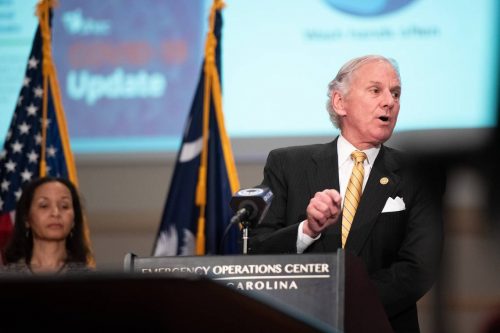
On Monday, South Carolina Governor Henry McMaster released his proposed budget for Fiscal Year 2026-27. This budget, developed in coordination with executive agency heads and presented to the General Assembly in January every year, not only outlines the state’s financial situation, but also offers insight into what Governor McMaster considers top priorities for the upcoming year.
After reviewing his proposal, we are encouraged to see significant investments in a number of key education policy areas, including teacher supports, school choice expansion, investments in early childhood literacy, and a college tuition freeze. Great policy must be followed by funding to support implementation, and we are hopeful that these investments are retained or even increased as the General Assembly begins budget deliberations in the coming weeks.
Investments in Teacher Supports
Governor McMaster has been a vocal supporter of our teachers throughout his gubernatorial career. If his budget request of $150 million to increase teacher pay is funded by the legislature, he will have succeeded in raising the minimum starting teacher salary from $31,113 to $50,500 – accomplishing his goal of a $50,000 minimum starting salary by 2026. This request also adds $2,000 to every cell of the state minimum teacher salary schedule, providing a meaningful pay increase for every teacher in the state.
The Governor has also requested $6.4 million to support the state’s strategic compensation pilot program and the Teacher Career Ladder program – ensuring that the most effective teachers are rewarded for their performance and leveraging their experience to mentor newer teachers. The legislature is well-positioned to fund these requests and to pass additional pro-teacher policies this year, ensuring that our teachers know that they are valued and supported in their efforts to prepare the next generation for life outside of the classroom.
Expansion of School Choice
The Education Scholarship Trust Fund (ESTF) is the state’s school choice program. Structured as an education scholarship account (ESA) and having survived a constitutional challenge looking to defeat the program, families across the state are thriving under the ESTF. Families are able to access funds that they need to send their child to a school that best meets their needs, whether that is a religious, charter, or independent school, or even if the family decides to educate their child at home.
Last year, the program was limited to 10,000 students – a number quickly met and surpassed, leading to a waiting list thousands of students long. Demand for the program is sure to continue to expand exponentially as the income eligibility limit increases from 300% of the federal poverty level to 500%. To address this, Governor McMaster is standing alongside Superintendent Weaver in requesting $61.4 million in new appropriations – enough to allow 20,000 students into the program, rather than the statutorily-mandated minimum of 15,000 students for this school year. We hope that the legislature will fund this request so students across the state are able to access the education options and environments that work best for them.
Freezing College Tuition
Governor McMaster has, for the seventh consecutive year, requested the necessary funds to support our postsecondary institutions in freezing college tuition for in-state students. According to research conducted by College Board (see graph below), in-state tuition at public four-year universities more than doubled over the last 30 years despite a slight decrease in cost in the years surrounding the COVID-19 pandemic.
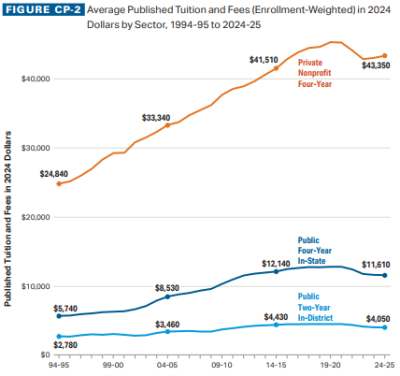
As of September 2025, 42.3 million students across the country hold $1.67 trillion in federal student loan debt, averaging out to nearly $39,500 per student. If we use a standard 10-year repayment timeline at an extremely low interest rate of 4% (well below the current federal student loan interest rates which range from 6.39% to 8.94%, depending on the type of loan), each student will pay nearly $48,000 total – more than $8,000 in interest. By taking the initiative and freezing college tuition for in-state students, we can help reduce the amount of student loans required to attend and help our students thrive after graduation.
Prioritizing Early Childhood Literacy
Over the last few years, South Carolina has taken an active role in revamping how we teach children to read, including the prohibition of three-cueing in instructional materials, ensuring that teachers are trained in the Science of Reading, and that students are not foolishly passed on to later grades without demonstrating that they are able to read at grade level.
To continue to support these reforms, Governor McMaster has requested $15 million for summer reading camps and $50 million for high-quality instructional materials. Summer reading camps are a valuable opportunity to remediate students who are not on track to be reading on grade level by the end of 3rd grade, and providing funding for high-quality instructional materials help ensure that teachers have access to the “best of the best” teaching materials to support literacy instruction. These kinds of early intervention policies, when paired with high-quality literacy curricula, can help bring students to grade level, prevent them from falling into South Carolina’s mandatory retention policy, and set them up for greater learning success down the road.
A Lasting Legacy
As Governor McMaster enters the final year of his historic ten-year governorship, we are confident that this education budget will help solidify his legacy as a true liberty-minded conservative who governed of, by, and for the people – and who left South Carolina better, more free, and smarter than he found it.