

Five Takeaways From South Carolina’s New ESA Program Application Data
After months of uncertainty and determined advocacy from families across the state, South Carolina’s restored and expanded ESA program, the Education Scholarship Trust Fund, is back—and rising stronger than ever for 2025–26. When parents spoke up, lawmakers listened and passed S.62, which Governor McMaster signed into law May 7, 2025.
Just a week later, ESTF applications opened back up for the 2025-26 school year. While the future of ESTF was still uncertain, a 2025-26 application window had been open January 15, 2025, through March 15, 2025, under the old program rules that required applicants had to have attended public school the previous year and have household income capped at 300% of the federal poverty line.
S.62 designated five priority groups for ESTF applications: the previous year’s ESTF recipients, their siblings, children of active duty military, those who attended public school the previous year, and, starting in 2026-27, households at or below 300% of the federal poverty line. Since the January 15 to March 15 window was limited to prior public school students, and renewals had already happened, ESTF applications kicked off in May with a week for military families to apply early. Then on May 19, applications opened up for all families at or below 300% of the federal poverty line, with far fewer restrictions on applicants than under the original ESTF law.
Even through a stop-and-start application cycle, South Carolina families never wavered. Their enthusiasm and determination to find the right learning environment for their children filled all 10,000 scholarships and created a waitlist that continues to surge past 8,000 as we approach 2026-27 applications.
The data from 2025-26 applications gives us some important details to consider as the ESTF program continues to grow, and as South Carolina legislators consider the future of school choice in the Palmetto State. Here are five important takeaways from the 2025-26 ESTF application data.
1. Parents from all 46 South Carolina counties applied—especially rural counties.
Opponents to ESTF often argue that students in rural parts of the state are not able to take advantage of this program because of the lack of alternative education options in their communities. However, with the rise of robust online education and other flexible uses for ESTF, the reality is that families in every part of South Carolina have an abundance of options for how to use their scholarship funds.
We see that clearly shown in the county-by-county application data, which shows that ESTF applicants resided in every single county in South Carolina, from Greenville and Richland, all the way to McCormick, Allendale, and Dillon.
The heat map below shows the raw number of ESTF applicants per county.
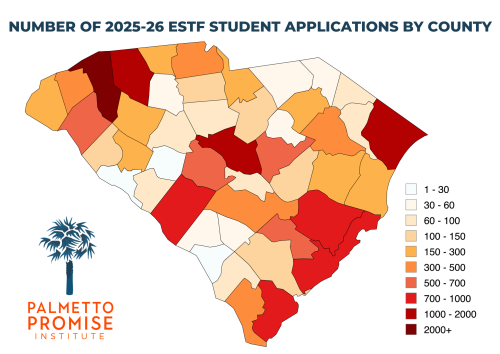
Notably, the greatest number of applications were from Greenville, Richland Spartanburg, and Horry counties—an expected outcome, as those are four of the state’s highest populated counties. Charleston, however, which ranks #3 in terms of overall population, is #8 in terms of ESTF application numbers, a sign that perhaps the program’s income cap (300% of the federal poverty line in 2025-26) limited the participation of those who live in Charleston County, or perhaps just that future outreach about the program should target Charleston in particular.
County-by-county data is best compared when indexed for population. The map below looks at 2025-26 ESTF application numbers per county as a percentage of a county’s total population (according to 2020 census data).
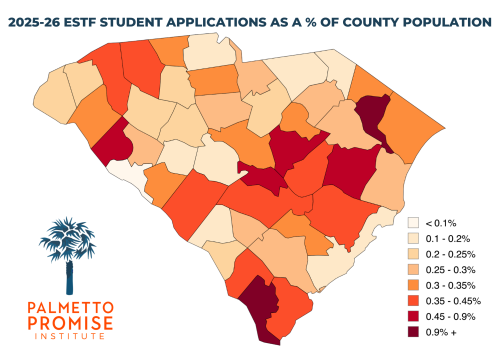
Fascinatingly, Jasper and Marion counties are far and away the ESTF application leaders when adjusted for county population. These two rural counties are part of South Carolina’s notorious “corridor of shame” and are largely rural and lower income.The data makes one truth unmistakable: families in these communities are hungry for opportunity and ready to seize every chance to give their children a brighter future. Jasper and Marion are not outliers; across the board, the greatest proportion of ESTF applicants came from rural, low income communities, like Abbeville, Sumter, Williamsburg, Calhoun, Orangeburg, and Hampton counties. When compared to county population, Greenville and Spartanburg ESTF applicants take spots #11 and #12 instead of #1 and #2.
The takeaway?
Rural families are just as—and perhaps even more—excited about the opportunities provided by ESTF as those in urban areas where nonpublic school options may be geographically closer to families. Rural families are willing to make those sacrifices, getting creative with alternative, hybrid education options or driving longer school commutes, if it means access to a better education for their children.
2. These scholarships are reaching the families who need them most.
A common misconception about school choice programs is that they primarily benefit wealthy families. The 2025–26 applicant data proves the opposite. Of the more than 16,000 students who applied, 8,561 are Medicaid recipients—meaning over half of all applicants come from families with low incomes or children with documented disabilities.
This is one of the clearest signs that ESTF is doing exactly what it was designed to do: opening doors for families who have historically had the fewest options. And even as income eligibility expands to 500% of the federal poverty line in 2026–27, families at or below 300% will continue to receive priority, ensuring that lower-income students remain at the heart of the program.
3. Military and special needs families especially are being served.
Throughout the debate over S.62, lawmakers made clear that military families and students with special needs should be among the first to benefit from expanded educational opportunity. The 2025-26 application data shows that vision becoming reality.
For military families, often limited to a single public school based on where they are stationed, ESTF has opened doors that were previously closed. More than 10% of all applicants have a parent serving in the U.S. Armed Forces, a sharp increase from 7.6% the year before, and that surge came after just one week of early priority access. We expect participation to climb even higher in 2026-27.
Special needs students, though not given early priority status, are also seeing meaningful access. Ten percent of all applicants have documented disabilities, a powerful sign that families are finding the individualized environments and services their children need. Parents have shared story after story—children finally receiving intervention therapies, thriving in smaller classrooms, and discovering schools that understand and support their unique learning journeys.
These numbers aren’t just good data points; they reflect lives being changed by opportunity.
4. Technical changes to the program are paying dividends for parents.
Perhaps the biggest takeaway from the applicant data is that changes to the application and eligibility process implemented in S.62 are paying off and making the application process significantly easier and more understandable for parents to navigate.
- A lower percentage of applicants are being rejected for misunderstanding program rules, like having a kid outside K5-12 age.
- Zero applicants were denied for missing application deadlines—because S.62 eliminated the strict January 15 to March 15 application window with no forgiveness for parents to submit additional documentation after the application window closes. Last year, thousands of families missed out on scholarship opportunities because they were unable to get applications submitted on time. Eliminating the rigid application window removed a major barrier for families, opening the door for thousands who might otherwise have been left behind.
- Removing the prior public school attendance requirement has made applications easier and allowed more parents to access the program when they have been scraping together funds and pinching pennies to cover private school tuition out of pocket.
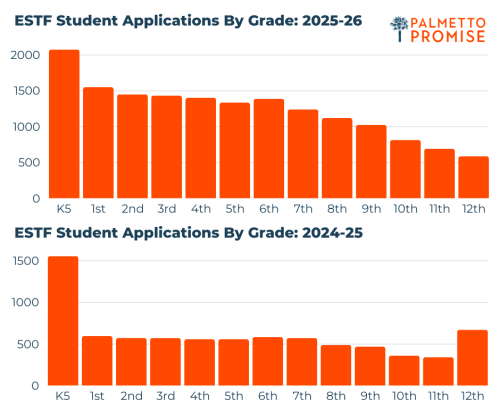
- Applications saw a more even distribution of grades in the applications. This can likely be attributed to the removal of the prior public school requirement, as kindergarten students in 2024-25 did not have to meet that requirement, but students in first grade onward were limited and could not have been homeschooled or private school students prior to their ESTF applications.
5. Nearly every 2024-25 student eligible to renew for another year did.
This might be the most remarkable statistic of all. Despite the court ruling that gutted the ESTF program just weeks into the 2024–25 school year, families who experienced ESTF during that turbulent year almost unanimously chose to participate again in 2025-26. That speaks to the profound impact of education choice—something these families saw firsthand as their children flourished in 2024-25. These parents fought for their scholarships to be restored, making their voices heard to legislators and advocating for their children.
At Palmetto Promise, we are especially proud of this data point, knowing that our ESTF Families Rescue Fund provided stability when funds were barred from being used for tuition and made it possible for thousands of children to remain in the program.
We expect the renewal rate for 2026-27 to be high as well—because when families finally gain access to real choice and opportunity, the results are life-changing.
What’s Next
2026-27 applications for the ESTF program are underway already. Current families can renew their participation and add in any siblings who don’t receive the scholarship already, up until January 15. Then, at 8:00AM on January 15, applications open for students who fall within one of the remaining priority groups: have a parent who is active duty military, attend public school in the 2025-26 school year, or have a household income at or below 300% of the federal poverty line. Priority applications are processed and approved on a first come, first serve basis, based on when application documents are submitted.
Then, on February 9, at 8:00AM, the general application window opens, for all households with income up to 500% of the federal poverty line.
Not sure if your family is eligible? Take our free, easy prescreening quiz that walks you through the process.
And watch our 2026-27 application webinar for guidance through the process, information about what documents are needed for your application, and everything you need to know to make sure your student can take advantage of this incredible opportunity. Our team is here to support families as they navigate the ESTF process. Visit SCSchoolChoice.com to learn more.
Conclusion
Families across South Carolina are hungry for choice, eager for opportunity, and ready to chart a better path for their children. The extraordinary demand for ESTF is a testament to what’s possible when families are finally given options that meet their needs.
Now is the moment for legislators to build on this momentum. By expanding the number of ESTF scholarships in the 2026 state budget, they can ensure that every family—not just the first 15,000—has the chance to unlock the doors that educational freedom makes possible.