Penalizing Charter Schools for Their Success?
When COVID hit, many parents who were suddenly homebound used that extra time to investigate what kind of education their children were receiving. In some cases, it didn’t require much sleuthing. After all, COVID forced parents to experience lessons and assignments in real time. Student achievement, course content, and funding at their zip code-assigned traditional public school (TPS) were among the areas that attracted the attention of parent-taxpayers. Since then, with a broader view of the options available to their children, non-TPS options have enjoyed explosive growth. Enrollment in private schools, home schools, Magnet school programs, and public Charter schools is up. Traditional public school enrollment is down.
Looking at data collected by the state, we can be precise about that shift. Since the 2019-20 school year, public Charter enrollment has grown by over 27,000 students while Average Daily Membership for traditional public schools has decreased over 11,000. That represents a 90% growth for public Charters and a 2% decline for traditional public schools.
Charter enrollment is in blue below and follows the left axis. Traditional Public School data is in orange and follows the right axis.
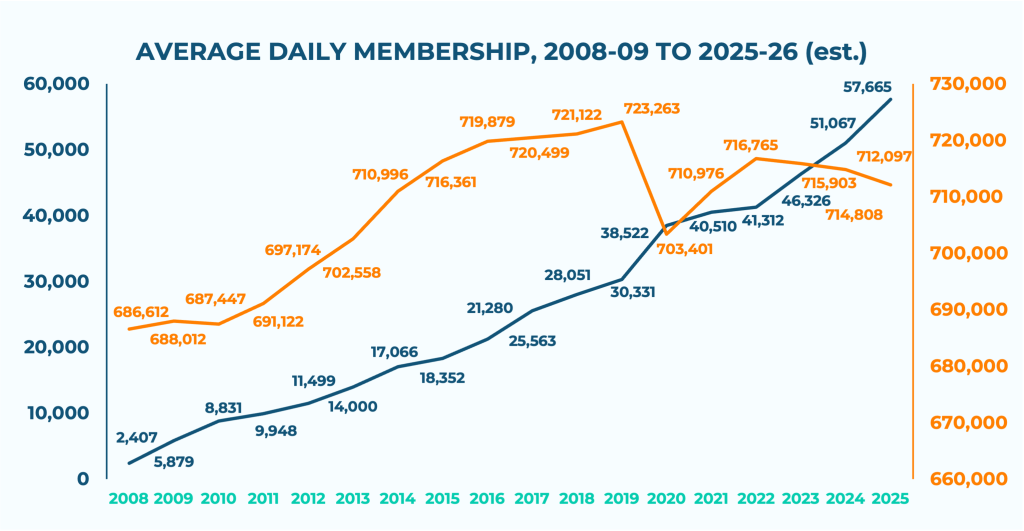
This growth for Charters did not seem possible as recently as 2022. At that time, public Charters were at a serious disadvantage for receiving funding that compensated for their growth. Capital funding was nearly non-existent, and statewide public Charter districts received no local funds, just statewide funds, while traditional public schools enjoyed a mix of state, local, and federal funds.
Furthermore, a major source of funding for public Charters was Education Improvement Act (EIA) funds. The EIA has always been raided for education priorities of all kinds, and rising public Charter enrollment was just another mouth for the General Assembly to feed with EIA funds. Statewide Charter authorizers were forced to go to the legislature every year, essentially for one-time funds to cover their success. While traditional public school districts submitted enrollment numbers and were automatically compensated, public Charters were standing in line for money to cover their new students from a multipurpose fund.
With the 2022 state budget, all that finally changed, twenty-five years after Charter schools were enacted into law. This meant student-centered funding from the more typical source of education funds. With more certainty and headcount-based funding, public Charter school networks began to attract national Charter organizations to provide help with construction of school buildings. In a very short time, with the funding predictability and the capital problems solved, Charters began to finally realize their full potential for growth in the Palmetto State.
But the new funding system was short-lived. In the waning days of the 2025 legislative session, a proposal was floated to reduce per pupil spending for online Charter schools in order to bulk up funding for traditional public schools. The shift in the new funding pot was approximately $9 million from public Charters to TPS, ostensibly taking funding from virtual Charters only. This was a departure from the new formula adopted in 2022.
The impact of this change on the ground is illustrated by the experience of Heron Virtual Academy of South Carolina, which serves at-risk students, including a high percentage of students in poverty. Heron expects to lose $1.3 million compared to what they would have received with the former formula, which their leaders say will lead to cuts in “wraparound” services like social workers and counselors, services that are essential for students with academic and behavioral challenges like those at Heron.
That’s just one example of the ramifications of the change.
So, is it time to push the panic button? What does the legislature’s backtracking on public Charter funding in the 2025 budget mean for the future of public Charter schools?
Our concern is that this “one-year patch” could lead to serious permanent cuts, even to the return of the bad old days when Charter school students were not funded fairly. Public Charters are transforming lives across South Carolina, even in “The Corridor of Shame.” Many of them also have waiting lists, some as large as their current student bodies. To account for that, we need to stay on the fair funding path laid out in 2022.
Palmetto Promise Institute will monitor this situation as the Charter funding issue becomes front and center later this summer and into the fall with the release of a new fiscal study commissioned by the General Assembly.
We have made too much progress in school choice in South Carolina to start backtracking so early. Surely the General Assembly gets that.