
South Carolina Shines in National Report Tracking Federalism Threats
Since at least the Great Depression, the federal administrative state has expanded its reach dramatically. This is a severe challenge for democracy. But fortunately, South Carolina is holding its own…for now. In the State Policy Network’s annual Federalism Scorecard, the Palmetto State ranks 5th in the nation—that means South Carolina is the fifth least vulnerable to encroachment of federal power for 2025.
Federalism, the division of powers between the state and federal government, is a fundamental concept outlined in the United States Constitution. However, a state’s sovereignty can be at risk when the federal government exercises power outside of the powers granted to it within the Constitution. Federal agencies have asserted the power to create rules with which states must comply or risk penalties. Federal overreach can occur when these agencies create regulations that go beyond what is expressly approved by Congress in legislation. But because agency bureaucrats are not elected officials, they are not held accountable to voters at the ballot box.
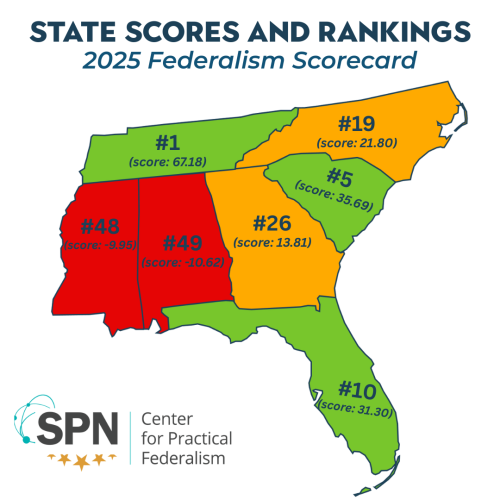
There are many states in this nation that are working tirelessly to maintain their sovereignty and constitutionally granted powers. South Carolina was one of the states recognized by SPN’s scorecard for preserving federalism, with one of the highest scores of 35.69.
How Are Scores Calculated?
The State Policy Network takes two factors into account when calculating scores:
- Internal rules: rules that govern a state’s executive branch agencies
- External rules: rules that affect the ability of federal agencies to influence state decision-making.
Within these two factors, they are further subdivided into the following categories, used to determine how protected states are from vulnerabilities:
- Internal rules: Oversight Committees, Judicial Non-Deference, Agency Lobbying Restricted, Legislative Regulatory Review, Independent Regulatory Review, Injunctive Relief for Citizens, Null and Void Statutes, Legislative Subpoena Power
- External rules: Legislative Oversight of Grants, Legislative Intervention on Grants, Elected Executives Oversee Grants, Exemptions from Grant Oversight, Contingency Plans for Federal Fund Loss, Federal Grant Cost Accounting, Federal Grant Transparency & Implementation, Guidance Transparency, Oversight of Clean Air Act SIPs, Oversight of Medicaid State Plans, Magnitude of Federal Lobbying by State Agencies, State Revenue from Federal Funds
Each state is rated on their vulnerability by being rated either: “unprotected against agency influence,” “vulnerable,” or “stronger than average.” To determine how a state falls within these ratings, the situation is often nuanced, so the developers of the report had to make a few judgment calls.
Interpreting South Carolina’s Score
South Carolina’s high ranking reflects its strong commitment to preserving state authority and ensuring that governance remains firmly in the hands of its own elected officials. Compared to other states in the Southeast, South Carolina is among the leaders. See the map below to see how South Carolina compares to our neighbors.
How Can South Carolina Improve Its Score?
Though South Carolina is already leading the charge on federalism, The State Policy Network offers areas of improvement. These are subcategories where South Carolina received the ranking of “unprotected against agency influence.” The following is a list of some of the areas where we could improve, many of which require state legislation:
- Null and Void Statuses: Language in some state statutes nullifies them if they come into conflict with federal regulations or guidance in ways that jeopardize federal funds. By caving to the promise of more federal revenue, the legislatures that enacted these statutes have abrogated their lawmaking responsibility and made their communities unnecessarily vulnerable to federal influence.
- Injunctive Relief for Citizens: When state agencies initiate an action that a citizen believes is illegal or unconstitutional, it can be difficult to get a hearing in court. Tennessee is the only state that guarantees every citizen affected by an agency’s action a relatively simple opportunity to seek an injunction until the legality of that action is determined.
- Agency Lobbying Restricted: At present, only two states curtail the ability of state agencies to lobby their legislatures, and no state restricts the ability of state agencies to lobby federal agencies. While it’s essential to maintain communication between legislators and officials tasked with implementing the laws, it’s also important to restrain agencies from pursuing their own agendas. Constraints on the ability of state agencies to lobby their own legislatures are necessary in defense of federalism because federal agencies can quietly influence state agency officials through a variety of means, in effect making them their proxies in statehouses.
- Judicial Non-Deference: In 2024 the US Supreme Court restrained, in its Loper Bright Enterprises v. Raimondo decision, the previously wide latitude exercised by federal agencies in their interpretation of federal laws. Many states similarly restrict the ability of their executive branch agencies to decide for themselves what state laws mean. South Carolina defers too much to agencies. REINS legislation that has passed the SC House will fix this problem.
- State Revenue from Federal Funds: The more dollars a state receives from federal agencies, the more vulnerable it is to agency demands. There are many reasons a state may receive an above-average percentage of its revenue from Washington, DC, and many of those reasons are beyond a state’s control. SPN incorporates this variable nonetheless, because it indicates a significant vulnerability to federal influence. South Carolina’s budget is among the most vulnerable in dependence on federal funds.
- Oversight of Medicaid State Plans: As with the Clean Air Act, federal laws regarding Medicaid give states latitude to tailor the plans to their particular needs. States create Medicaid State Plans, which are then sent to the Center for Medicaid and Medicare Services (CMS) for approval.
- Oversight of Clean Air Act SIPs: Some federal laws give states latitude to tailor them to particular state needs. States are asked in such instances to craft what is known as a State Implementation Plan (SIP) for approval by the federal agency overseeing the law. State agencies can sometimes change key elements of these SIPs without the agreement or knowledge of elected officials, and sometimes even with subsequent enforcement taken up by federal officials. States requiring that changes to key SIPs receive legislative scrutiny guard themselves against secretive lawmaking.
- Federal Grant Transparency and Implementation: States are required to follow reporting guidelines for federal grants and have some visibility through websites such as USASpending.gov. This variable assesses individual states’ laws and practices around how they disclose receipt and expenditure of federal moneys, and in particular, whether those practices yield transparency and public accessibility.
- Contingency Plan for Federal Fund Loss: There is no guarantee that most federal grants will continue to flow to states, yet many states fail to maintain even rudimentary plans for minimizing harm and disruption in the event of a delay, reduction, or cessation of federal funds. Some even fail to track which programs at the state and community level are dependent on federal versus state or local revenues, meaning that they get blindsided in the event of funding reductions or delays. These accounting and planning failures leave them vulnerable not to disruption, but to federal bullying. If you have no idea how you can get along without an agency’s money, you’re more inclined to do whatever its officials demand.
- Exemptions from Grant Oversight: Several states require some form of elected-official oversight of federal grants but exempt certain state entities from that oversight. Entities frequently favored with such exemptions are state university systems, even though many public universities actively lobby federal agencies for rules and laws that conflict with the desires of a majority of their state’s citizens, and accept grant strictures that obstruct the authority of state legislators to govern what are taxpayer-supported, public institutions.
- Legislative Oversight of Grants: Some states don’t give their legislatures authority over federal grant applications but do require that specific legislators be notified of impending awards after state agencies have applied for those grants and give them time to scrutinize and veto those awards. The State of Georgia, for example, requires a presentation to legislative leaders of information, including the intended use of new federal grant funds, the timeframe for use, and estimates of fiscal and other impacts. Other states require agencies to place federal grant information in an online portal or other central information source (see, for example, the portal required by the state of Missouri) that legislators could presumably peruse if they had an interest, but the agencies are not required to place specific cost and regulatory content before legislative leaders and staff, with a time lag allowing for intervention. Such transparency is laudable compared to no reporting at all, but it does not indicate active legislative oversight of federal grant acceptance.
Conclusion
The Palmetto State’s #5 ranking on the State Policy Network Center for Practical Federalism’s Federalism Scorecard demonstrates that protecting the constitutional powers of the state is a top priority for South Carolina. While federal agencies continue to expand their regulatory reach and bureaucratic creep, South Carolina stands out as a model for balancing cooperation with the federal government and safeguarding local autonomy. Palmetto Promise is supportive of making the recommendations from the Center for strengthening agency oversight and reducing dependence on Washington a legislative priority. It is our goal to rise in the rankings and defend our state. We are grateful to the State Policy Network’s Center for Practical Federalism for tracking this important issue.